

Why More “Coverage” Doesn’t Always Mean More Effective Delivery
Some manufacturers promote a crosshatch laser pattern as a major selling point — claiming that placing lasers in perpendicular and parallel orientations increases scalp coverage. At first glance, that sounds compelling. More overlap. More coverage. More light everywhere. But here’s the engineering reality: the crosshatch layout exists because of the beam shape of traditional edge-emitting laser diodes.
1️⃣ Why Crosshatch Patterns Exist

Traditional edge-emitting diodes release light from the side edge of the chip. Because of that geometry, the beam naturally exits as:
- Elongated (elliptical)
- Uneven across axes
- More prone to lateral spread
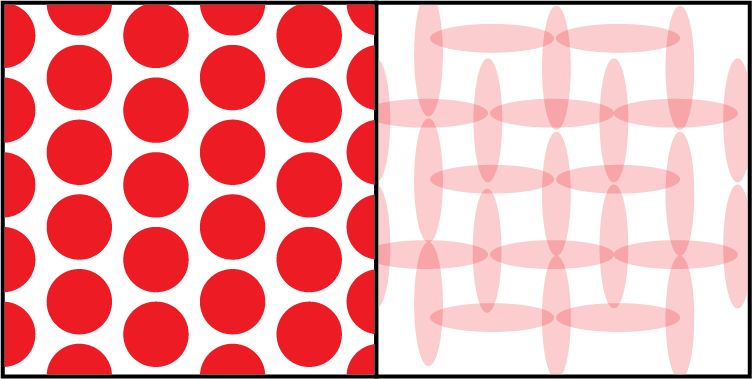
As the beam travels toward the scalp, it widens in one direction more than the other. That spread reduces energy density. To compensate, manufacturers rotate some diodes 90 degrees and alternate their orientation — creating a crosshatch pattern. The overlapping elongated beams help fill visual gaps in coverage. Yes — this can increase the area that light touches. But increased area is not the same as increased intensity.
2️⃣ The Flashlight Effect
Think of it like a flashlight. When you shine a flashlight close to a wall, the light is bright and concentrated. As you move farther away, the beam spreads wider — but becomes weaker per square inch. More surface area is illuminated. Less power is delivered to any one point. An elongated laser beam behaves similarly.
As it spreads laterally:

- Energy disperses
- Power density drops
- Intensity at the target decreases
Crosshatching increases the illuminated area — but each individual beam is still elongated and spreading. Coverage increases. Concentration decreases. In therapeutic light delivery, power density matters.
3️⃣ Surface-Emitting Lasers: Direct and Circular
Surface-emitting laser architectures (such as SMT VCSEL designs) operate differently. Instead of emitting from the edge, light exits directly from the surface — straight down toward the scalp.
This produces a beam that is:

- Circular (round) Symmetrical
- Evenly distributed
- Focused at the target
Because the beam is inherently round and directed downward:
- There is less lateral dispersion
- Energy remains concentrated
- Power density is preserved
There is no need to rotate diodes or create crosshatch compensation patterns — because the beam geometry does not require it.
The Engineering Distinction
Crosshatch layouts are often marketed as “more coverage.” And each laser may illuminate a wider footprint. But wider illumination is not the same as stronger delivery.
An elongated beam that spreads will always lose intensity as it covers more area — much like a flashlight beam expanding across a wall. The energy gets dispersed as it travels. A circular, vertically emitted beam maintains concentration and directs energy where it is intended to go.

Light Dispersion: Concentrated Energy vs Diffused Energy Cross-Hatch Pattern. (Deeper red illustrates energy concentration)
In laser therapy, the question isn’t simply: How much area is lit? It’s: How much usable energy reaches the target? And beam geometry determines the answer.
Share:
The Next Leap in Laser Therapy: How Surface-Mount Technology Is Changing the Game
Androgenetic Alopecia, Hair Miniaturization & Laser Therapy