

Not All "Diodes" Are Lasers: What Every Red Light Therapy Buyer Should Know
If you're shopping for a red light therapy device, you've probably seen the word "diodes" used over and over in product descriptions.
But here's what many consumers don't realize:
Not all diodes are lasers.
In fact, both laser diodes and LEDs (Light Emitting Diodes) are technically "diodes." That means a company can advertise that its device contains diodes without ever telling you whether those diodes are actually laser diodes or simply LEDs.
Many consumers understandably assume that if a product mentions "diodes," it must be referring to lasers.
It isn't.
If a manufacturer is proud of using laser diodes, they will usually say exactly that. If a product only advertises "diodes," "light diodes," or "medical-grade diodes," it's worth asking one simple question:
Are they laser diodes or LEDs?
The answer matters more than you might think.
Laser Diodes and LEDs Are Not the Same Technology
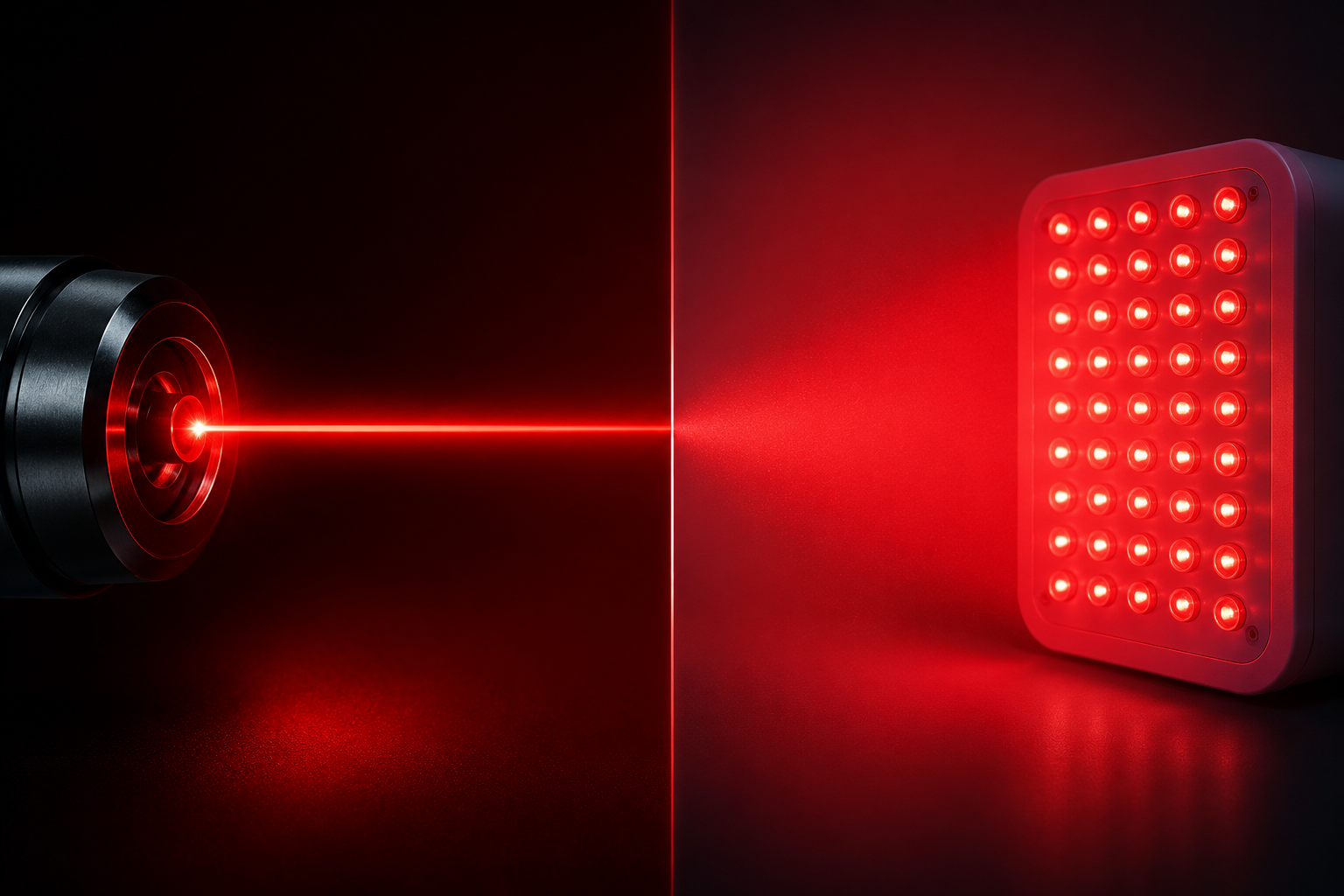
Although both can produce red light—even at the exact same wavelength—they are fundamentally different technologies.
Laser Diodes
Laser diodes produce:
- Coherent light
- Highly focused beams
- Minimal beam divergence
- Precise optical energy delivery
- Consistent power density
Because laser light remains tightly concentrated, it delivers energy much differently than a broad light source.
LEDs
LEDs produce:
- Non-coherent light
- Wide-angle illumination
- Significant light spread
- Less concentrated optical energy
Rather than producing a focused beam, LEDs emit light that spreads outward immediately after leaving the source.
Think of the difference this way:
A laser is like a spotlight.
An LED is like a floodlight.
Both produce light.
They simply deliver it differently.
The Wavelength Isn't the Whole Story
Many products proudly advertise that they use 650 nm red light.
While wavelength is important, it tells only part of the story.
Two devices can both use 650 nm light while using completely different light sources.
Other equally important factors include:
- Whether the light source is a laser diode or an LED
- Beam divergence
- Optical output power
- Irradiance delivered to the treatment area
- Energy density
Simply comparing wavelengths does not tell you whether two devices perform similarly.
Cost Matters, Too
Another important difference between laser diodes and LEDs is manufacturing cost.
Laser diodes are significantly more expensive to manufacture than LEDs.
They require tighter manufacturing tolerances, more sophisticated engineering, and more precise optical components.
LEDs are considerably less expensive to manufacture, which is one reason they are found in countless consumer products ranging from flashlights and televisions to decorative lighting and many wellness devices.
Because LEDs generally cost much less than laser diodes, consumers should understand exactly what technology they're paying for.
A premium price does not automatically mean a device contains premium technology.
Some products are marketed using technical terms like "diodes" without clearly explaining that the light sources are LEDs rather than laser diodes.
That's why it's important to ask one simple question:
Are these laser diodes or LEDs?
Knowing the answer helps you understand what technology you're actually purchasing—and whether the price reflects the technology inside.
More Lights Sometimes Doesn't Mean Better
Another common marketing tactic is emphasizing the number of light sources.
You'll often see products promoted with claims such as:
- 32 diodes
- 64 diodes
- 120 diodes
- Hundreds of diodes
While those numbers may sound impressive, the number alone doesn't tell the whole story.
The first question should always be:
What kind of diodes are they?
A device containing 32 LEDs is not directly comparable to a device containing laser diodes simply because both use the word "diodes."
Only after you've confirmed you're comparing the same technology does the number of laser diodes become a meaningful specification.
When comparing two laser-based devices, factors such as the number of laser diodes, optical design, power output, treatment coverage, and engineering all become important.
Likewise, when comparing two LED devices, the number and arrangement of LEDs may also matter.
The key is to compare apples to apples.
Before comparing the number of diodes, first determine whether they're laser diodes or LEDs.
Only then can you make an informed comparison.
Laser Diodes vs. LEDs at a Glance
| Feature | Laser Diodes | LEDs |
| Light Type | Coherent | Non-Coherent |
| Beam | Highly Focused | Wide-Angle |
| Light Spread | Minimal | Significant |
| Precision | High | Lower |
| Manufacturing Cost | Higher | Lower |
| Light Delivery | Concentrated | Diffuse |
| Marketing | Usually clearly identified as "laser diodes" | Sometimes marketed simply as "diodes" |
Questions Every Buyer Should Ask
Before purchasing any red light therapy device, ask the manufacturer:
- Are these laser diodes or LEDs?
- How many laser diodes are used?
- What wavelength is used?
- Is the device FDA-cleared for its intended use?
A reputable manufacturer should have no problem answering these questions clearly.
Marketing Terms Can Be Misleading
Watch for descriptions such as:
- Advanced diodes
- Medical-grade diodes
- Red light diodes
- Precision diodes
- High-performance diodes
While these phrases may sound impressive, they don't tell you what kind of diode is actually inside the device.
Remember:
Every laser diode is a diode.
Not every diode is a laser.
That's why consumers should look beyond the marketing language and ask exactly what technology is being used.
The Bottom Line
Choosing a red light therapy device involves much more than comparing the number of lights or the wavelength printed on the box.
Before making a purchase, find out exactly what type of light source the device uses.
If the manufacturer proudly uses laser diodes, they will usually tell you.
If they only advertise "diodes," ask whether those diodes are actually lasers or simply LEDs.
It's one of the most important questions you can ask—and one that can help you make a more informed buying decision.
Remember:
Every laser diode is a diode.
Not every diode is a laser.
Know the difference before you buy.
Share:
Androgenetic Alopecia, Hair Miniaturization & Laser Therapy
How to Compare Laser Hair Growth Devices with Confidence