Why Does the Light Source in Your Hair Device Actually Matter?

When Endre Mester accidentally regrew hair on shaved mice with a ruby laser in 1967, he stumbled onto something that would take medicine decades to fully appreciate: specific wavelengths of coherent red light can wake dormant hair follicles from their sleep.
That discovery eventually became a clinical discipline — low-level laser therapy, or LLLT — and in 2007 the FDA cleared the first home-use laser device for treating pattern hair loss. Since then, dozens of devices have flooded the market. Some use only lasers. Others mix lasers with LEDs. And a few rely on LEDs alone.
The distinction is not cosmetic. It is the single most important engineering decision that determines whether a device can deliver therapeutic light where it matters — deep inside the scalp, at the base of the hair follicle.
Lasers vs. LEDs: The Physics That Separate Them
To understand why this debate matters, you need to understand three properties of light that affect biological tissue: coherence, collimation, and monochromaticity.
A laser diode produces coherent light — waves perfectly synchronized, traveling in the same direction, at a single precise wavelength. This combination allows the beam to penetrate tissue with minimal scatter, delivering concentrated energy directly to the target chromophore in the mitochondria of follicle cells: cytochrome c oxidase (CCO).

An LED, by contrast, emits incoherent, divergent light across a broader spectral band. The photons scatter as they enter tissue, spreading their energy across a wider area but penetrating less deeply. Think of it as the difference between a focused stream of water from a garden hose and a gentle mist from a sprinkler. Both deliver water. Only one reaches the roots.
The American Hair Loss Association has addressed this directly, noting that LLLT lasers produce coherent light that penetrates deeper into the scalp and targets hair follicles more effectively, while LEDs emit light that tends to scatter with reduced therapeutic impact. The organization also points out that while substantial clinical evidence supports LLLT for hair loss, the data on LED caps remains limited, with most LED studies focused on general skin health or wound healing rather than hair growth.
What the Clinical Evidence Actually Shows
The scientific literature on photobiomodulation for hair loss is nuanced, and intellectual honesty demands acknowledging that. Some researchers argue that photobiomodulation does not depend on coherence, and that when wavelength and dose are precisely matched, LEDs can trigger similar cellular pathways. A 2018 review in Photochemical & Photobiological Sciences reached this conclusion — though the same paper cautioned that the quality of head-to-head comparisons between lasers and LEDs was generally low.
Here is what is not ambiguous: every FDA clearance for home-use hair regrowth devices in the 635–670 nm range has been substantiated by clinical data involving red laser light — not LEDs alone. The clinical trials that the FDA accepted as evidence of efficacy used laser diodes to demonstrate statistically significant increases in terminal hair counts. No device has received FDA clearance based solely on LED evidence for hair regrowth.
A systematic review and meta-analysis published in the Journal of Cosmetic Dermatology examining 32 FDA-approved home-use LLLT devices found that 87.5% were composed exclusively of laser diodes, and the analysis revealed a significant difference between laser and non-laser light sources.
The practical takeaway: lasers have the clinical track record. LEDs have theoretical promise and some supporting research, but they have not independently crossed the evidentiary threshold that the FDA requires for hair regrowth clearance.
How iRestore Uses LEDs — And Why It Matters

iRestore's devices combine lasers and LEDs in what the company calls "Lumitech™" technology. The iRestore Professional uses 282 total diodes — a mix of lasers and LEDs — while the newer Elite model contains 500 diodes combining 300 lasers and 200 LEDs at three different wavelengths (625 nm, 655 nm, and 680 nm).
iRestore markets this combination as providing "broader uniform coverage to fill in the gaps in-between lasers." On the surface, that sounds reasonable. But it raises a critical question: if LEDs are clinically effective for hair regrowth on their own, why does iRestore need lasers at all?
The answer appears to be that iRestore recognizes — whether explicitly or implicitly — that lasers do the therapeutic heavy lifting. The LEDs fill physical space between laser diodes, but the clinical substantiation behind iRestore's FDA clearance relies on the same red-laser evidence base that supports the entire LLLT device category. The LEDs inflate the total diode count on the spec sheet without independent proof that they contribute to hair regrowth outcomes.
There is also the wavelength question. The iRestore Elite's triple-wavelength approach includes 625 nm LEDs — a wavelength that falls below the 630–670 nm therapeutic window that decades of photobiomodulation research has identified as optimal for follicle stimulation. Meanwhile, iRestore's marketing discourages shorter treatment times, recommending 25-minute sessions for the Professional and 12-minute sessions for the Elite, every other day. This longer treatment protocol may be necessary precisely because the LED components deliver less concentrated energy per diode.
What Makes Xtrallux Different: Pure Lasers, Advanced Engineering
Xtrallux takes the opposite approach. Every single diode in every Xtrallux device is a true 650 nm red laser. There are no LEDs mixed in. No filler light. No inflated diode counts.
This matters because 650 nm sits squarely in the sweet spot identified by decades of photobiomodulation research — the wavelength range where CCO absorption is maximized and follicle stimulation is most effective. Published studies, including RNA sequencing transcriptome analyses, have confirmed that 650 nm red light triggers the specific cellular pathways associated with hair growth.

But the real engineering breakthrough is what happens at the diode level. Xtrallux is currently the only laser cap manufacturer on the market integrating Surface-Mount Technology (SMT) with Vertical-Cavity Surface-Emitting Lasers (VCSELs) into a hair regrowth device. While SMT laser technology has appeared briefly in other devices in the past, no other company currently offers it — making Xtrallux the sole option for consumers who want the most advanced laser engineering available today.
What Is SMT VCSEL Technology?
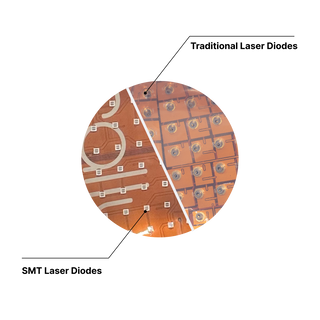
Traditional laser caps use through-hole diodes — individual laser components inserted and soldered through holes in a circuit board. This manufacturing method works, but it creates physical constraints: each diode protrudes from the board, adding bulk and limiting how densely engineers can pack them together.
SMT flips this approach. Each VCSEL laser is mounted directly onto the surface of the circuit board, allowing engineers to position diodes closer together with greater precision. The result is a device that delivers:
More uniform energy distribution — light spreads evenly across the scalp, eliminating the undertreated dead spots that can occur with traditional diode spacing. This is the same coverage benefit iRestore claims to achieve with LEDs, except Xtrallux accomplishes it with actual lasers.
Higher energy density per diode — VCSELs emit light perpendicular to their surface in a tightly controlled beam, delivering more concentrated therapeutic energy to each follicle with minimal loss between source and skin.
Greater precision at the target wavelength — VCSELs maintain more stable wavelength output than traditional edge-emitting laser diodes, ensuring every session delivers light precisely at 650 nm.
A thinner, lighter, more comfortable design — surface-mount assemblies have a lower physical profile than through-hole arrays, which translates to laser domes that sit flatter against the head.
Improved durability and reliability — fewer mechanical solder joints mean fewer potential points of failure over the life of the device.

How the Lineup Compares
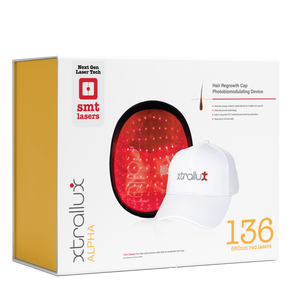
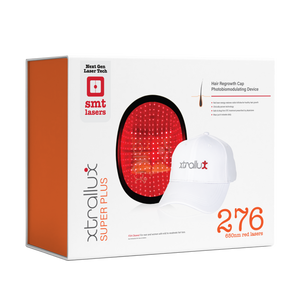
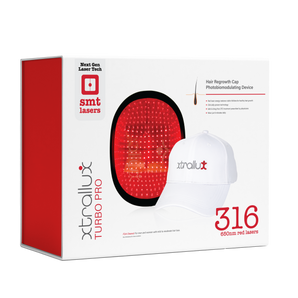
Xtrallux offers three models — the Alpha (136 laser diodes), the Super Plus (276 laser diodes), and the Turbo Pro (316 laser diodes). All use SMT VCSEL technology at 650 nm. All require just 6 minutes of daily use.
Compare that to iRestore's flagship Professional at 282 mixed lasers and LEDs requiring 25-minute sessions three times per week, or the Elite's 500 mixed diodes at 12 minutes every other day.

The FDA Clearance Question
Both Xtrallux and iRestore are FDA-cleared Class II devices for treating androgenetic alopecia. But FDA clearance for this device category is based on the predicate device pathway — meaning new devices demonstrate substantial equivalence to previously cleared devices. The foundational clinical data supporting this entire category comes from studies using red laser light in the 635–670 nm range.
There is no separate FDA clearance for 808 nm infrared wavelengths for hair regrowth. In fact, 808 nm is the wavelength range associated with FDA-cleared hair removal devices — the biological opposite of what someone with hair loss wants. Some competitors have introduced 808 nm into their devices with bold marketing claims, but the clinical substantiation simply does not exist for that wavelength in hair restoration.
Xtrallux stays within the clinically proven parameters: pure 650 nm laser light, the same wavelength family that every clinical trial in the FDA's clearance pathway has validated.
What Hair Restoration Physicians Say

Board-certified hair restoration surgeons — the physicians who see hair loss outcomes daily — have weighed in on this debate. Dr. Ken Williams, past president of the American Board of Hair Restoration Surgery and a fellow of the International Society of Hair Restoration Surgery, recommends laser light therapy as part of a comprehensive medical management program for hair loss. Dr. Williams has noted that the mechanism of action keeps hair in the anagen (growth) phase longer and strengthens it through subsequent cycles. He personally uses and advocates for Xtrallux, specifically citing its high laser diode count, manufacturing quality, and the significant warranty backed by a company with deep experience in the field.
Dr. Shelly Friedman, founding president of the American Board of Hair Restoration Surgery — a board-certified surgeon with 36 years of experience treating over 20,000 men and women for hair loss — has been equally direct. Dr. Friedman has explained that the best laser cap is determined by how many actual laser diodes it contains, comparing the energy difference to that between a 40-watt bulb and a 3,300-watt bulb. More diodes deliver more power, which translates to more energy reaching the follicle — and more chances of stopping hair loss progression.
Critically, Dr. Friedman has also drawn a clear line between lasers and LEDs in the context of hair regrowth. He has stated plainly that LED diodes do not penetrate the skin deeply enough to reach the hair follicle, whereas laser diodes do. In his view, if a device has enough laser diodes delivering energy at sufficient depth, progression of hair loss can be halted. It is a distinction that goes to the heart of the Xtrallux-versus-iRestore comparison: one device uses only the light source that reaches the follicle, while the other pads its count with a light source that a leading hair restoration surgeon says falls short.

These are physicians whose reputations depend on recommending treatments that work. Their endorsement of all-laser devices reflects a clinical judgment informed by years of patient outcomes.
The Bottom Line: What Should You Choose?
The hair regrowth device market is crowded, and marketing claims can be louder than science. Here is what the evidence supports:
Laser light at 650 nm is the most clinically validated wavelength for stimulating hair follicles. Every FDA clearance in this category traces back to clinical trials using red lasers, not LEDs.
Xtrallux is currently the only device offering SMT VCSEL technology — the most advanced laser engineering available in a home-use hair cap, delivering more precise, uniform, and stable energy than traditional through-hole designs.
iRestore's LED-laser hybrid approach inflates diode counts without independent clinical evidence that the LED components contribute to hair regrowth. The longer treatment times may reflect the lower energy density of the LED portion of their devices.
Compliance drives results. A 6-minute daily session is easier to maintain than a 25-minute session every other day. The device that stays on your head consistently is the device that works.
If you are investing in a laser cap for hair regrowth, the question is not which device has the most diodes on the box. It is which device delivers the most clinically proven therapeutic energy to your follicles, with the engineering precision to ensure every session counts.
On that basis, Xtrallux stands apart.
This article is for informational purposes only and does not constitute medical advice. Consult a board-certified dermatologist or hair restoration specialist before beginning any hair loss treatment. Individual results vary. Xtrallux and iRestore are FDA-cleared for the treatment of androgenetic alopecia in men and women with mild to moderate hair loss (Fitzpatrick Skin Types I–IV).
Frequently Asked Questions
Are LEDs effective for hair regrowth?
LEDs show theoretical promise for photobiomodulation, but no home-use device has received FDA clearance for hair regrowth based solely on LED evidence. The clinical trials supporting FDA clearances in this device category all used red laser light. The American Hair Loss Association notes that while LLLT has substantial clinical evidence for hair loss, LED data remains limited and mostly focused on skin health and wound healing.
How many laser diodes does Xtrallux have compared to iRestore?
Xtrallux's Turbo Pro has 316 pure laser diodes — all true 650 nm lasers. iRestore's Professional has 282 mixed lasers and LEDs, while the Elite has 500 mixed diodes (300 lasers + 200 LEDs). Xtrallux does not count any LEDs because it does not use them.
Why is Xtrallux's treatment time shorter?
Xtrallux devices use SMT VCSEL lasers that deliver more concentrated energy per diode than traditional laser designs or LEDs. This higher energy density means follicles receive a therapeutic dose in 6 minutes daily, compared to 12–25 minutes required by iRestore devices.
What is SMT VCSEL technology?
Surface-Mount Technology (SMT) combined with Vertical-Cavity Surface-Emitting Lasers (VCSELs) is an advanced manufacturing approach where each laser is mounted directly onto the circuit board surface rather than inserted through holes. This allows for denser, more precise, more uniform laser arrays with better energy delivery and improved durability.
Is 808 nm effective for hair regrowth?
There is no FDA clearance for 808 nm wavelength devices for hair regrowth. In fact, 808 nm is the wavelength range used in FDA-cleared hair removal devices. All clinical evidence supporting LLLT for hair regrowth involves wavelengths in the 630–670 nm red light range.
Does iRestore's FDA clearance prove LEDs work for hair growth?
iRestore's FDA clearance is based on the predicate device pathway, which relies on demonstrating equivalence to previously cleared laser-based devices. The underlying clinical evidence supporting this device category involves red laser light. The LED components of iRestore devices have not been independently validated for hair regrowth through FDA-accepted clinical trials.
References
Sources cited in "Laser Cap vs. LED Helmet for Hair Regrowth: Why Xtrallux Outperforms iRestore"
-
"Understanding the Differences Between Red Light Therapy, LED Caps, and Low-Level Light Therapy Devices for Hair Loss"November 2024americanhairloss.org
-
"Photobiomodulation: Lasers vs. Light Emitting Diodes?"Photochemical & Photobiological Sciences, 17, 1003–1017 (2018)PubMed Central — PMC6091542
-
"The Effectiveness of Low-Level Light/Laser Therapy on Hair Loss"Facial Plastic Surgery & Aesthetic Medicine (2024)journals.sagepub.com
-
"A Systematic Review and Meta-analysis of Randomized Controlled Trials of United States FDA-Approved, Home-use, Low-Level Light/Laser Therapy Devices for Pattern Hair Loss: Device Design and Technology"Journal of Cosmetic Dermatology (2021)PubMed Central — PMC8675345
-
"Role of Low-Level Light Therapy (LLLT) in Androgenetic Alopecia"Journal of Cutaneous and Aesthetic Surgery (2022)PubMed Central — PMC8906269
-
"Photobiomodulation for the management of hair loss"Photodermatology, Photoimmunology & Photomedicine (2021)Wiley Online Library
-
"Hair Growth Promoting Effects of 650 nm Red Light Stimulation on Human Hair Follicles and Study of Its Mechanisms via RNA Sequencing Transcriptome Analysis"Annals of Dermatology, 33(6), 553–561 (2021)
-
"What's the Best Laser Cap for Hair Regrowth in 2026?"xtrallux.com — Comparison Guide
-
"Xtrallux Introduces Breakthrough Surface-Mount Laser Technology for Hair Therapy Devices"August 2025xtrallux.com — Press Release
-
"LLLT Hair Loss Treatment | SMT & VCSEL Laser Therapy"xtrallux.com — Technology
-
"Why LLLT Is the Safest Hair Loss Therapy You Can Choose"xtrallux.com — Science Series
-
"Xtrallux vs Imitation Brands"xtrallux.com — Comparison
-
Past President, American Board of Hair Restoration Surgery; Fellow, ISHRSxtrallux.com — Physician Video
-
Founding President, American Board of Hair Restoration Surgery; 36 years experience, 20,000+ patients treatedxtrallux.com — Physician Testimonials